
In part 1 I got home, and in part 2 the house started running itself. This last part is about the automations nobody shows off. And they're the ones that justify the whole thing.
A silent sensor is not a calm sensor
Leak sensor gets wet → alarm. Obviously. Both phones, through silent mode, and it repeats every 5 minutes while it's wet, because a warning only helps if someone actually goes and shuts the water off.
But there's a second automation: leak sensor goes quiet → alarm.
Wait, an alarm for a sensor doing nothing? Yes. Look at the screen:
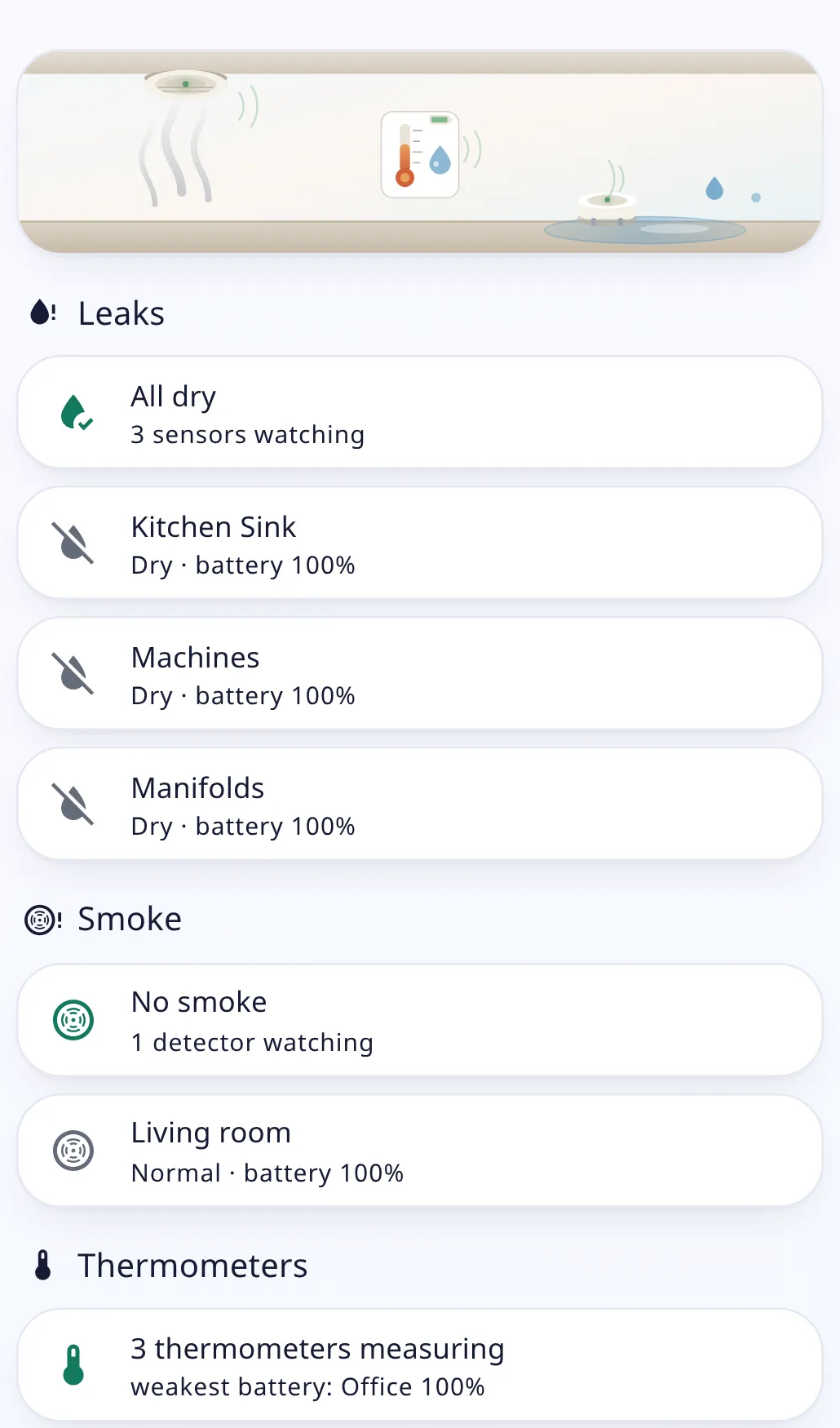
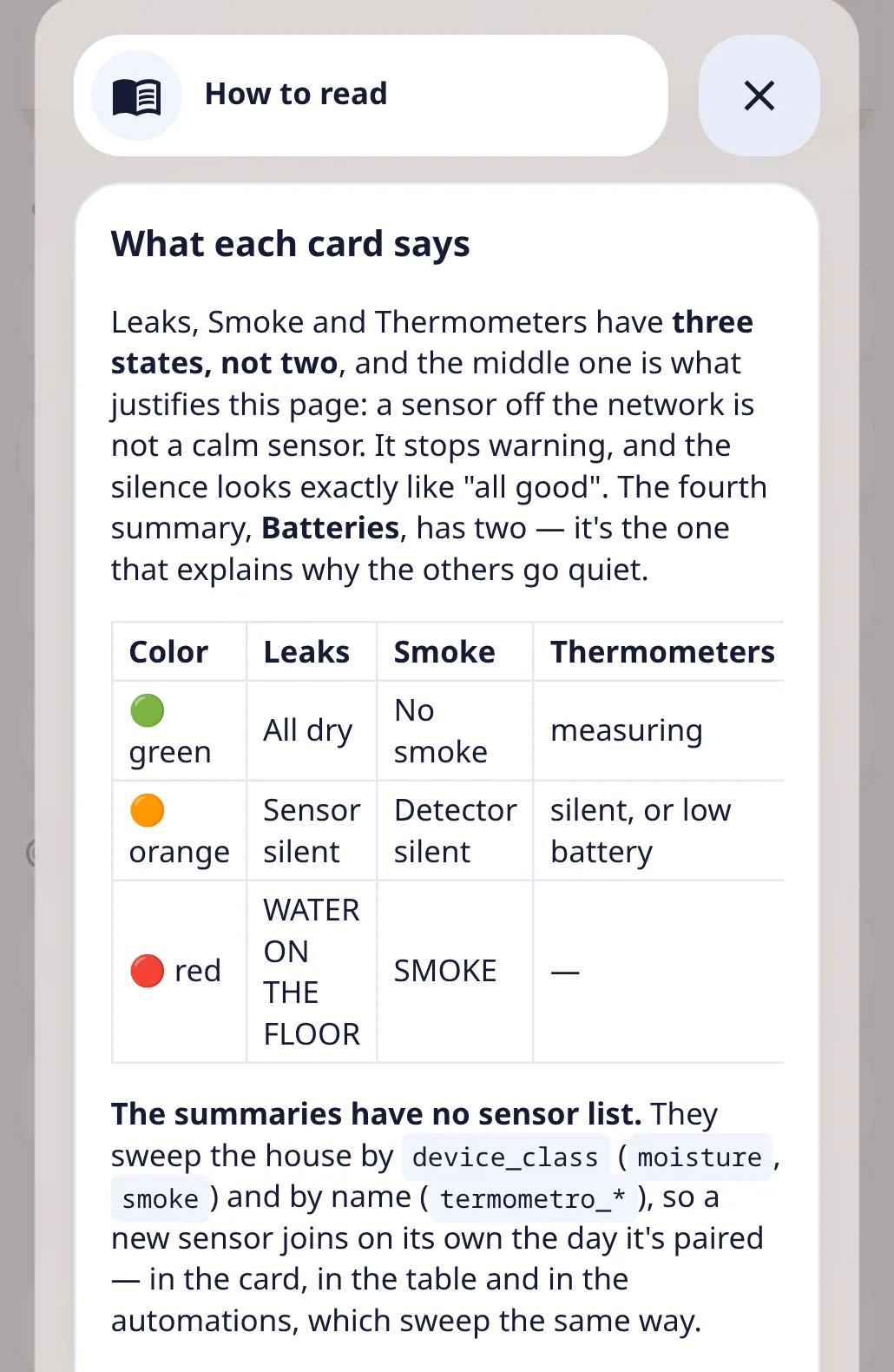
Every card on it has three states, not two:
- Green → fine.
- Red → water on the floor.
- Orange → a sensor that stopped reporting.
The orange one is the reason the page exists. A sensor off the network doesn't warn you about anything, and its silence looks exactly like "all good".
The smoke detector gets the same treatment, plus a monthly reminder to test it by hand. If it goes off, the lamps turn on at full brightness, both phones ring, and it repeats every 2 minutes. Why two and not five? Water ruins the parquet. Smoke kills in minutes.
There's deliberately no test button on the dashboard. The self-test beeps loudly for several seconds, and one accidental tap on the kitchen tablet would set it off (no, thank you). The test lives in the monthly reminder, where you have to read before you tap.
Everything checks in
Every battery in the house checks in once a day, at 11:00, all in a single message. Silent water sensors and silent detectors get their own warnings five minutes later, so if it's a dead battery, the three messages tell the same story.
Shelly firmware updates announce themselves. And after a restart, the MQTT bridges get asked to announce themselves again, because otherwise half the house comes back as unavailable.
Small-scale prophecy
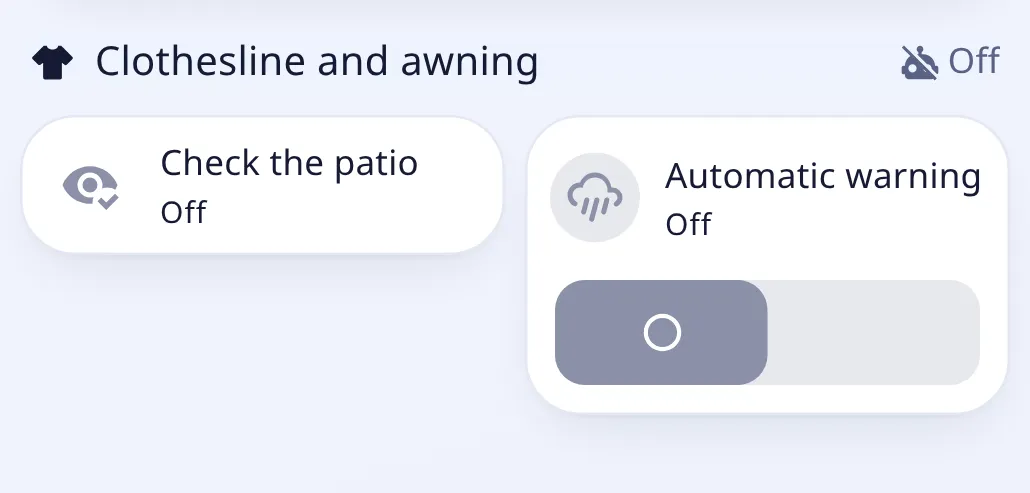
My favourite piece of small-scale prophecy: the clothesline and the awning get a warning before the rain or the wind arrives, not after. Nothing digital happens, it just tells me to go outside and deal with it.
And none of these warnings tells me when things are back to normal. On purpose: a second message saying "it's over" is how you teach someone to ignore the first one.
And this is where the day job leaked in
Go back and look at everything in this post. Health checks. Heartbeat monitoring. Alerting on the absence of a signal, not just the presence of one. Scheduled self-tests. A daily report on fleet state. And from part 1: a tunable timeout exposed in the UI instead of buried in a config file.
I spent years building exactly this for test suites, and never once thought to point it at my own apartment. Read it with QA eyes:
- A sensor that goes silent → a test that fails when the assertion never runs.
- A flaky sensor → a flaky test. It works 95% of the time, which is the worst possible number.
- The GPS glitch that once disarmed my alarm → a false positive with great-looking data.
- The car automation that fired correctly at a terrible moment → a passing test nobody trusts.
You can't unit test a gate motor. But you can absolutely build one that tells you when it's lying to you.
The house is a system under test. It just happens to also be where I sleep.
That's the series. Running Home Assistant Green, YAML-first, with a dashboard built on Bubble Card and Mushroom. Got a boring automation that quietly saved you? Tell me in the comments, and I'm happy to go deeper on any of these.